Field Notes Refrigerator Repair · Bothell
How to Stop a Sub-Zero Fridge From Sweating
Stop a fridge sweating: seal every door on a clean gasket, dry the room air, then trace any drip that remains.
- Filed
- Reading
- 5 min
- Applies to
- Sub-Zero built-ins · Bothell, WA
- Author of record
- Dean Halvorsen Refrigeration technician — sealed systems and airflow Years at it: 19 EPA 608 certified
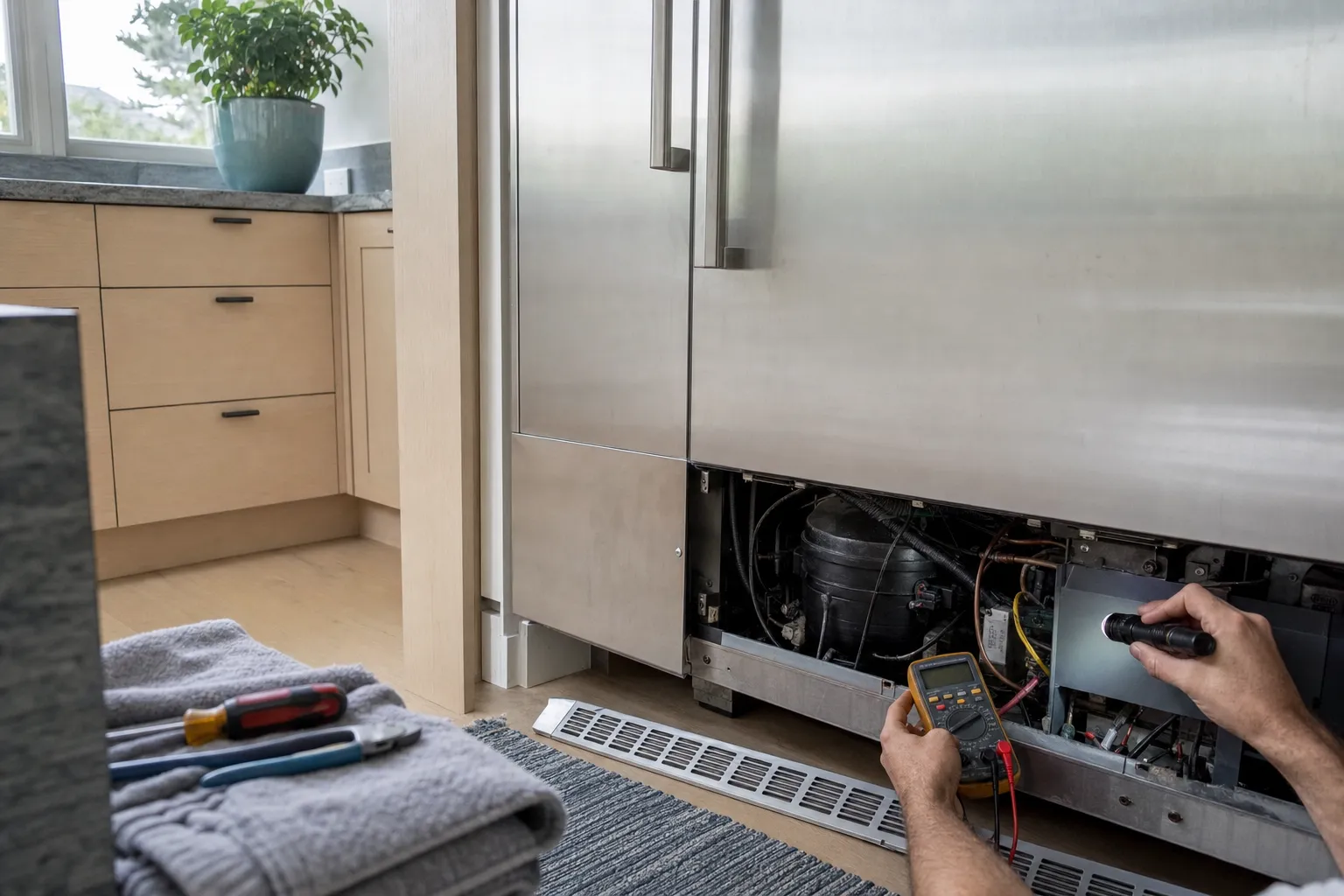
Most sweating stops once three things are true: every door closes hard against a clean, unbroken gasket, nothing inside is propping a door open, and the room air is not unusually damp. Beads of water form wherever moist kitchen air touches a surface colder than its dew point, so the cure is either to keep the cold in or to take moisture out of the air. If water keeps turning up after that, it is probably not sweat at all but a drain, a pan or a water line, and the quickest way to tell is to notice exactly where it sits. Built-in Sub-Zero units sit flush with the cabinetry, so a slow drip can hide behind the bottom grille for days before anyone spots it.
Where the water sits tells you what it is
| Where you find water | Likely cause | First step |
|---|---|---|
| Beads on the door face or the strip between doors | Cold escaping past a seal, or a frame heater not warming | Test the gasket, then watch the strip |
| Droplets on interior walls and shelves | Humid air getting in | Latch the door and cover open food |
| Ice or a puddle under the crisper drawers | Blocked defrost drain | Thaw the area gently |
| A puddle on the floor | Drain pan, supply line or ice maker | Dry it, then watch where it returns |
The top two rows are true sweating. The bottom two are leaks, and our page on water under the unit matches each to its repair band.
Test the door gasket with a sheet of paper
Close the door on a sheet of printer paper at the top, middle and bottom of both sides, and slide it out each time. You should feel even drag everywhere. Where the paper slips out freely, cold air is spilling over the frame and wringing water out of the room. Before blaming the gasket, wash it with warm water and a little dish soap, because dried juice stops the magnetic strip pulling flat. Then hunt for a jar, a takeout box or a crisper drawer not pushed fully home, since any of them can hold a door a few millimeters open. A gasket that is torn, stiff or crushed will not recover with cleaning and needs replacing, priced once a technician has seen it.
A door left ajar leaves clues on the display
On Classic (CL) and Designer (DET, DEC) models, the cabinet goes dark on purpose if anything is left open, because the control kills the lights so they stop adding heat. Find a dark, damp interior? Close everything and wait one hour before assuming a failure. Owners of the 600, 648PRO and 700 Series may see EC40 next to a blinking Service light instead. That pairing says the freezer compressor has worked far past normal, often over an unlatched door, though a weak fan, a bad temperature sensor or the sealed system can set it off too. Under 10° warmer than your setting, a condenser cleaning is the sensible first move; more than 10° warmer with every door shut means a technician should look. Leave the code in memory while readings climb.
Damp air in a Bothell house
Condensation needs moisture, and Bothell supplies plenty. From fall well into spring the outdoor air stays cool and wet, windows stay shut, and vapor from showers, laundry drying indoors and a boiling kettle has nowhere to go. A refrigerator door is often the coldest surface in the kitchen, so it collects that vapor first. Run the bathroom fans longer, make sure the dryer vents outside, and think about a small dehumidifier if your windows also stream in the morning. Inside the unit, cover soups and cut fruit, let very hot leftovers cool briefly before they go in, and avoid standing with the door open while you choose a snack. Each habit trims the moisture that would otherwise end up as droplets on the back wall.
When the strip between the doors stays wet
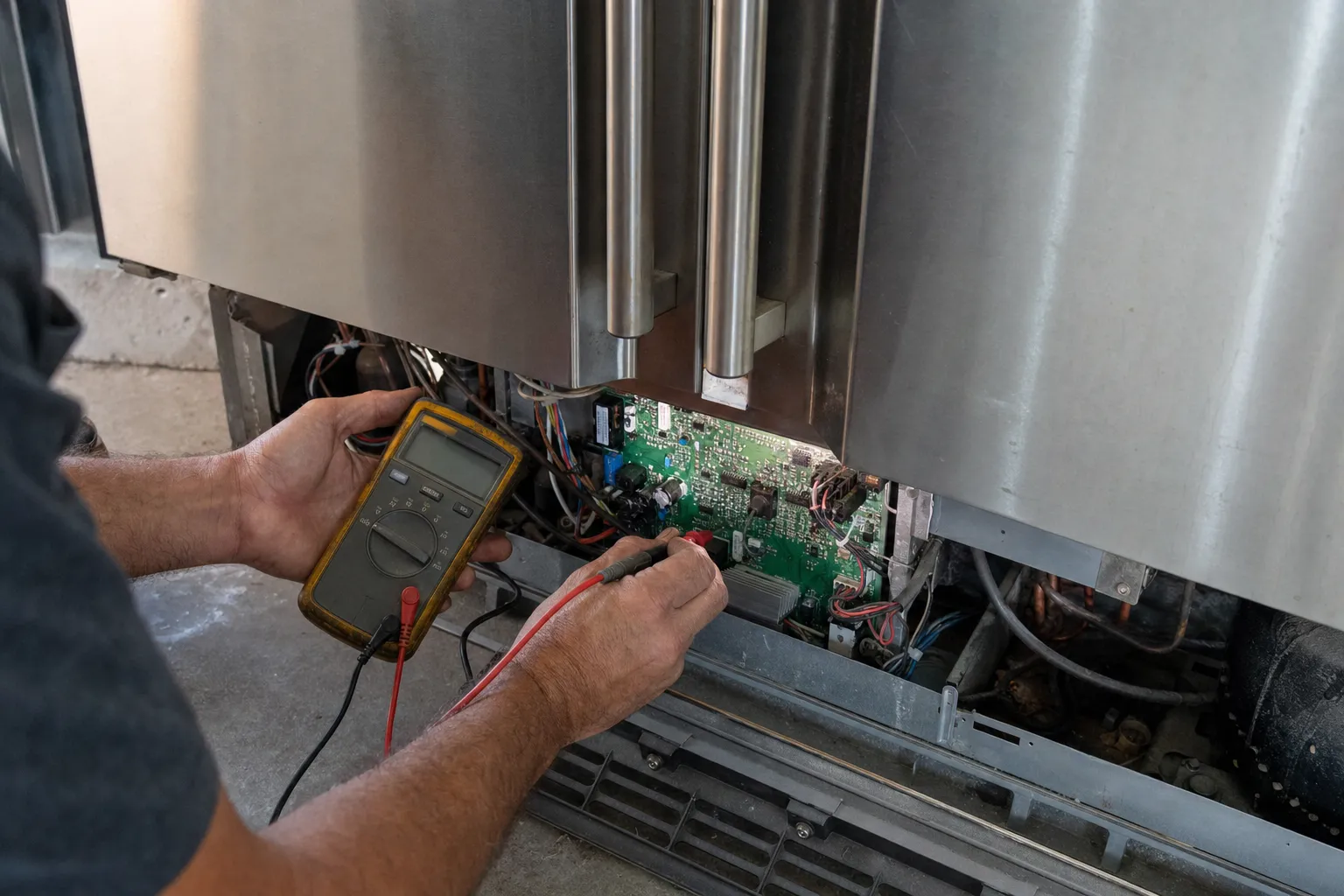
If the paper test passes and the kitchen is not humid, but water still lines up along the metal between the refrigerator and freezer doors, suspect the frame rather than the seal. Many refrigerators run a low-power heater just behind that strip to hold its surface above the dew point. When that heater, its wiring or the control that switches it fails, the strip runs cold, sweats all day and can even grow a thin skin of frost. It will feel clearly colder to your fingers than the rest of the cabinet face. This is not an owner fix, because it means removing trim and testing circuits under power. Jot down when the wetness appears and whether the box also reads warm, and pass that along when you book.
Drains, ice and the supply line
Water that pools under the crisper drawers, or ice spreading across the freezer floor, usually means the defrost drain has blocked, so meltwater from each defrost cycle has nowhere to go. Heavy ice there has to be melted with the unit switched off, and the right tool depends on the line. A hair dryer set low and kept sweeping is acceptable for the Classic (CL) and Designer (DET, DEC) lines, while PRO Series instructions rule it out in favor of a handheld steamer. If the ice keeps returning, our note on frost that comes back explains the defrost parts behind it. A floor puddle with dry doors and a dry interior points instead to the water line, the inlet valve or the ice maker.
When to hand it to a technician
Book a visit if water returns, the unit reads warm or the floor will not stay dry. Warmth and sweat together are not a weekend project: by Sub-Zero’s own reckoning, a box sitting above 48 with the setting at 38 rarely comes back from a condenser cleaning alone, and a unit younger than 6 months has no dusty condenser to blame. Our visit fee is $89 and it pays for the drive and a full look at the system; say yes to the repair and those $89 come off the final bill. We work across Canyon Park, Bothell Landing, North Creek and Maywood Hills; see our refrigerator repair page or call (206) 202-2799.
Follow-up questions
- Is a little condensation on a fridge door normal?
- A light mist that shows up on a muggy day and dries within the hour is usually just room air meeting a cold surface. Water that runs down the door, gathers in the same spot daily or comes with a soft, warm feel inside the box points to a seal or frame fault worth checking.
- Can setting the fridge colder make it sweat more?
- Yes, a colder setting chills the door edges and frame as well, so they hit the dew point sooner on a damp day. Keep the setting where food stays safe instead of turning it down to chase the problem, and put the effort into the seal.
- Why are the lights off and the shelves wet inside my Sub-Zero?
- A door or drawer probably did not close. Classic (CL) and Designer (DET, DEC) controls darken the cabinet when that happens so the lamps add no warmth, and humid air that slipped in condenses on the cold shelves. Push everything shut and give it one hour; lights still out after that means it is time for service.
- Should I silence the alarm while the unit dries out?
- You can, but quieting it fixes nothing. On Legacy Classic (BI) units, press the alarm and power buttons at the same moment and release them together within 5 seconds; the chime stops and the fault light stays hidden for 24 hours. Use that quiet day to arrange a visit, because the fault itself is still there.